
ESP32-S31 FUNCTION BOARD

This content is AI-translated and may differ from the original.
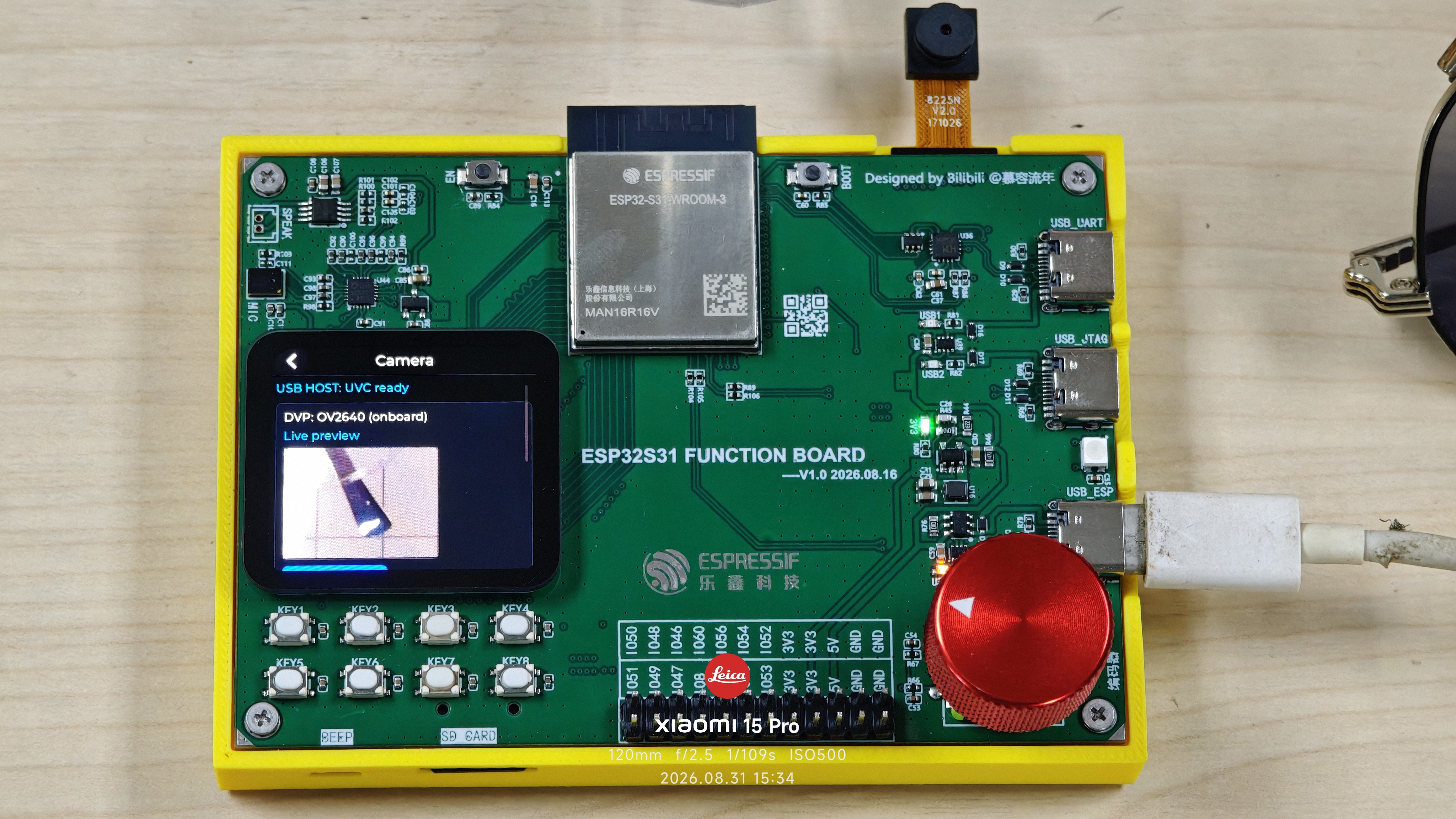
ESP32‑S31 FUNCTION BOARD V1.0
Project Overview
The ESP32‑S31 FUNCTION BOARD V1.0 is a multifunctional open‑source prototype development board built on Espressif's next‑generation ESP32‑S31 RISC‑V SoC. It features an onboard AMOLED display, a complete audio path, rich human‑machine interaction, SD storage, camera expansion and other peripherals, designed specifically for AIoT, GUI interaction, audio applications, and edge‑vision prototype verification. The hardware is drawn with Jialichuang EDA, and the schematic is fully open‑source, ready for direct board fabrication.
The ESP32‑S31 uses a dual‑core RISC‑V architecture with a maximum 320 MHz clock, supporting Wi‑Fi 6, Bluetooth 5.4 (LE Audio), Zigbee/Thread, and includes built‑in hardware JPEG codec, DVP camera interface, and high‑speed USB‑HS, delivering a substantial increase in compute and multimedia capabilities over previous generations. This board highly integrates common peripherals, lowering the hardware prototype development barrier for the ESP32‑S31.
Hardware Features
Main Controller and Power
- Main controller: ESP32‑S31, dual‑core RISC‑V, up to 320 MHz, supports DDR‑PSRAM expansion, 60 GPIO pins; integrates Wi‑Fi 6 / BLE 5.4 / 802.15.4 multi‑protocol wireless, built‑in hardware JPEG codec, 2D graphics acceleration unit.
- Power supply: Type‑C USB power; equipped with CH343P high‑speed USB‑to‑UART chip for firmware flashing and serial log output; LM66200 provides USB power path management and output current‑limit protection.
- Power system: 5 V‑to‑3.3 V DCDC buck circuit with multi‑stage power filtering to ensure stable operation; onboard WS2812 programmable RGB LEDs for device status indication.
- Function keys: BOOT download button and hardware reset button, facilitating firmware flashing, debugging, and system reboot.
Display Module
- Equipped with a 1.60‑inch AMOLED display, resolution 320×360, driven via QSPI interface, supporting TE screen‑refresh synchronization signal; MTP touch interface is brought out for external touch panels, suitable for LVGL graphical interface development.
Audio Subsystem
- Audio hardware solution: ES8311 audio CODEC + NS4150B Class‑D amplifier. The ES8311 is a low‑power 24‑bit audio codec with I2C configuration and I2S audio interface, supporting microphone recording and audio decoding output; the NS4150B Class‑D amplifier delivers up to 3 W output power, capable of driving speakers directly.
- Reserved microphone input pin for recording, voice capture, audio playback, and related functions.
- Onboard buzzer circuit for tone and alarm sound output; combined with ESP32‑S31 Bluetooth capability, it enables rapid development of LE‑Audio Bluetooth audio projects.
Human‑Machine Interaction Peripherals
- EC11 rotary encoder for menu navigation and parameter adjustment.
- 2×4 (8) buttons: using a 74HC165 parallel‑to‑serial shift register to expand button inputs, consuming only a few MCU GPIOs and saving I/O resources.
Storage & Vision Expansion
- SD card interface supporting SD storage cards for local data such as images, audio, and operation logs.
- DVP camera interface connecting to the ESP32‑S31 hardware camera controller, supporting image capture and hardware JPEG codec for edge‑vision AI prototype verification.
Communication Interfaces
1. CH343P USB‑to‑UART: firmware download and serial debug log output
2. ESP32‑S31 built‑in high‑speed USB 2.0‑HS OTG, customizable USB device functions
3. All I2C and SPI bus test points are brought out for easy connection of sensors and various expansion modules
Applicable Project Scenarios
1. ESP32‑S31 platform learning: become familiar with Espressif's next‑generation RISC‑V chip and conduct ESP‑IDF software‑hardware development practice
2. GUI development: LVGL graphical interface debugging, AMOLED interactive product prototype verification
3. Audio application development: local player, recording device, voice capture, LE‑Audio Bluetooth audio endpoint
4. AIoT and edge‑vision: camera image capture, hardware JPEG codec, lightweight vision AI prototype
5. DIY smart interaction devices: custom control panels, portable interactive devices, IoT endpoint prototypes
Open‑Source Information
Hardware version: V1.0
Design tool: Jialichuang EDA
Open‑source deliverables: schematic PDF, Jialichuang EDA source project files
⚠️ Usage Precautions
1. V1.0 is a prototype development board; before fabricating, carefully review the schematic, component specifications, and pin definitions.
2. Verify the BOM before soldering and confirm component packages; ESP32‑S31 is a brand‑new chip, pay attention to sourcing channels; ensure correct part selection for ES8311 and NS4150B.
3. This project is for learning reference only; risks associated with board fabrication, soldering, and actual use are the responsibility of the user.
4. Feel free to fork the project for modifications; personal learning can use it for free, but commercial use requires you to complete a full hardware reliability assessment.
Quick Start
1. Connect the development board to a computer using a Type‑C cable and install the CH343P driver.
2. Hold the BOOT button, press and release the reset button to enter firmware flashing mode.
3. Use ESP‑IDF to flash the firmware and sequentially debug the screen, encoder, buttons, ES8311+NS4150B audio, SD card, camera, and other peripherals.
4. Software development can be based on the official ESP32‑S31 SDK; the audio portion can leverage the esp_codec_dev component for rapid development.
Acknowledgements
This project is shared as open source, hoping to provide embedded enthusiasts with a hardware reference solution. Feedback on hardware issues and improvement suggestions are welcome.
Comments (0)
Comments
Sign in to leave a comment